



Key takeaways
- Fall stone picking goes faster when you start with a map. Fly a field after harvest to map the surface stones 20 cm (8″) and larger while the combine is parked and your crew still has time.
- Fly after your last fall tillage pass, or on stubble you won’t work again this fall. Working the ground after the flight changes what’s on the surface.
- TerraClear Rock Maps are delivered the next day on average, which leaves room to pick before freeze-up.
- Frost heave pushes new stones up over winter. Your fall map covers the fall pick and tells you which fields carry the most stone. If you pick again before seeding, map again after snowmelt. Book that spring map before spring to lock in the best rate.
- Farmers using a TerraClear Rock Map find about 3x more stones and pick about 3x faster.
How does a Rock Map speed up fall stone picking?
A TerraClear Rock Map shows you where the stones are before fall stone picking starts. You fly the field after harvest to capture full-field aerial imagery, and AI finds the surface stones 20 cm (8″) and larger. The map usually arrives the next day on average, with each stone at a precise GPS location and a precision plan, meaning the field-by-field action list that comes with your map.
The map covers the whole field, not a sample of it. The imagery is captured at 1.5mm ground sample distance, roughly 18 million pixels per acre, so the AI picks out stones a person driving by would take for a clod or miss in the stubble. Mapping runs on drones today. TerraScout®, TerraClear’s autonomous field scout, is set to join the mix, with first deliveries targeted for fall 2027.
It works through canola, pulse, and cereal stubble. The one condition is that the stone has to be visible from above. For how it works start to finish, see TerraClear Rock Management.
Why map stones in the fall instead of waiting for spring?
Fall has time that spring doesn’t. Harvest is done, and you know which fields just beat up the header.
Spring is short. On the Prairies, the stretch between snowmelt and seeding is tight, and every day spent chasing stones is a day the drill isn’t rolling.
Help is hard to find when you need it most. Danny Buls, who farms near Sumner, Iowa, said it plainly: “It’s hard to find the help to be timely, to get the rocks out of the way before the planter hits the field.” Growers on both sides of the border know that squeeze.
Harvest also just showed you where the problem is. The fields that ate guards and knife sections this fall are the ones to map first. That memory fades by March.
And the field is readable. Once the crop is off, stones that sat hidden in a standing crop all summer are visible from above again, even through residue.
Will a fall Rock Map still be accurate next spring?
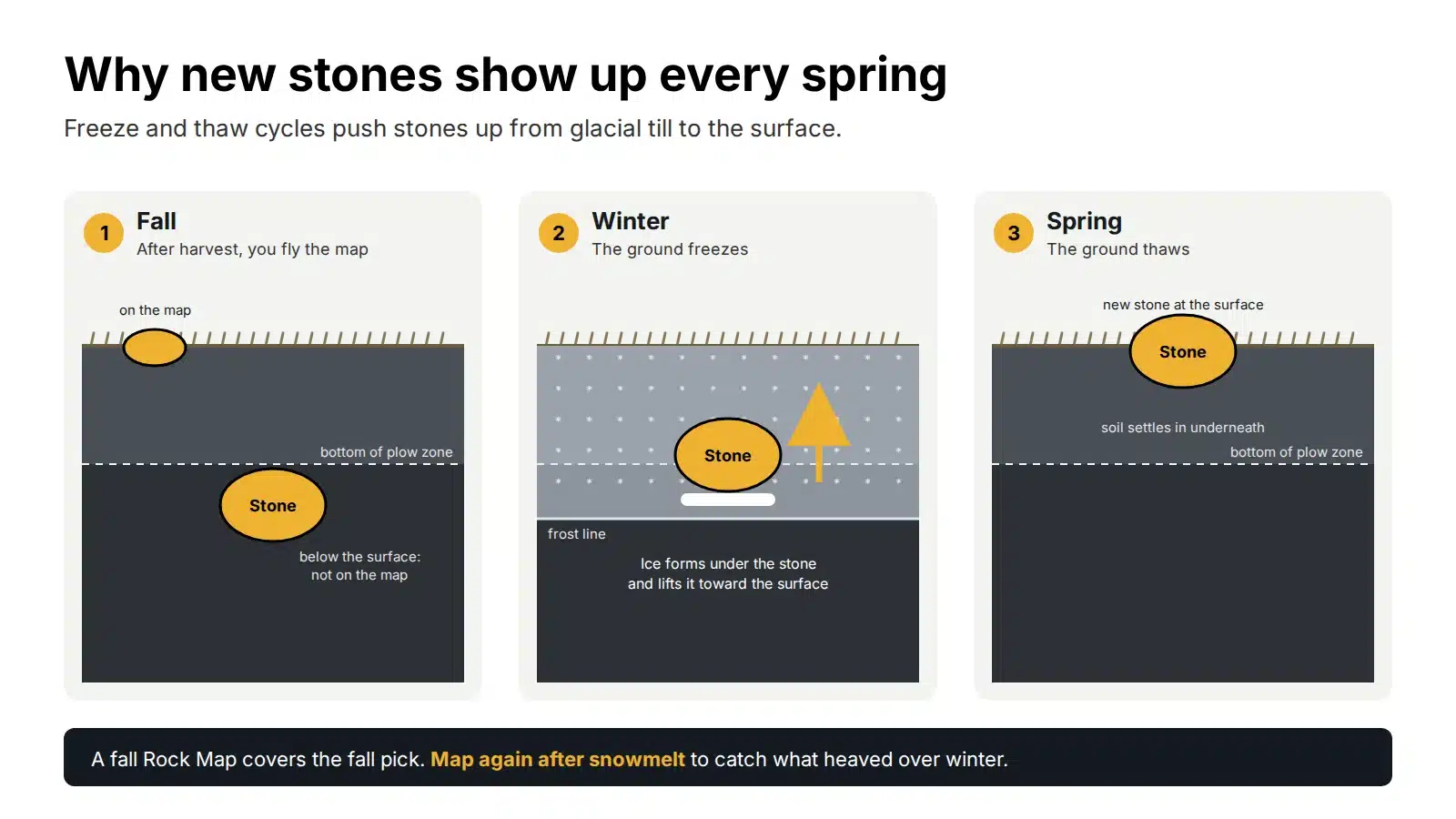
Not completely. A fall map shows the stones on the surface the day you fly. Over winter, freezing and thawing push more stone up, so some of next spring’s stones won’t be on it.
Prairie cropland sits on glacial till, which the Encyclopedia of Saskatchewan describes as a poorly sorted deposit containing everything “from grains of clay to boulders, jumbled together.” Frost does the rest. As the North Dakota Department of Mineral Resources explains, “seasonal freezing and thawing cause the rocks to work upward from below the plow zone to the land surface,” which is why “each spring, a new crop of stones has to be removed from the fields.”
That’s why a TerraClear Rock Map is a seasonal tool. Two rules follow from it:
- Don’t work the ground between the flight and the pick. Tillage moves stones and brings new ones up. Once you fly, leave the field alone until you’re done picking.
- Match the map to the pick. Use the fall map for the fall pick. If you plan to pick again before seeding, map again after snowmelt and before any spring tillage.
So what is a fall map for? Two jobs. It gets the fall pick done faster. And it gives you a field-by-field read on where stone is heaviest, so you know which fields go first next spring. If you know you’ll want a spring map too, buy it before spring. That locks in the best rate.
When should you fly a fall Rock Map?
Fly once the field looks the way it will when you pick it. For most operations that means after harvest and after your last fall tillage pass, with enough time left to pick before the ground freezes.
| Your fall plan | When to fly | Why |
|---|---|---|
| Fall tillage | After your last tillage pass | Tillage moves stones and exposes new ones. Map the field as you’ll leave it. |
| Direct seeding or leaving stubble | Any time after harvest | The map works through canola, pulse, and cereal stubble. |
| Fall-seeded winter wheat or fall rye | After harvest, before seeding | Get the stones out before the drill goes in. |
| Snow on the ground | Wait | Stones have to be visible from above. |
Freeze-up varies a lot by year and by location. Talk to your rep early so the flight lands with room to pick afterward. Talk to a rep about a fall map.
How do you plan a fall pick from a Rock Map?
Start with your worst fields, pull the biggest stones first, and work from the map’s route instead of hunting. Here’s the order most farmers follow:
- Rank your fields. Compare maps and start where stone is heaviest, or where the combine took damage this year.
- Filter by size. Set the size filter to the stones that break iron and pull those first. Come back for smaller ones if time allows.
- Set your entry and exit. Mark where you’ll come into the field and where you’ll leave so the work fits your yard and your loads.
- Follow the route. Turn on route guidance for an optimized pick route. Tap any pin to see a photo of that stone, so you can spot it as you pull up.
- Share and track. Send the map to your crew. Tracking shows which ground is covered and which stones are picked, whether you’re in the cab or somewhere else.
- Leave the ground alone until you’re done. Hold off on tillage until the mapped stones are out.
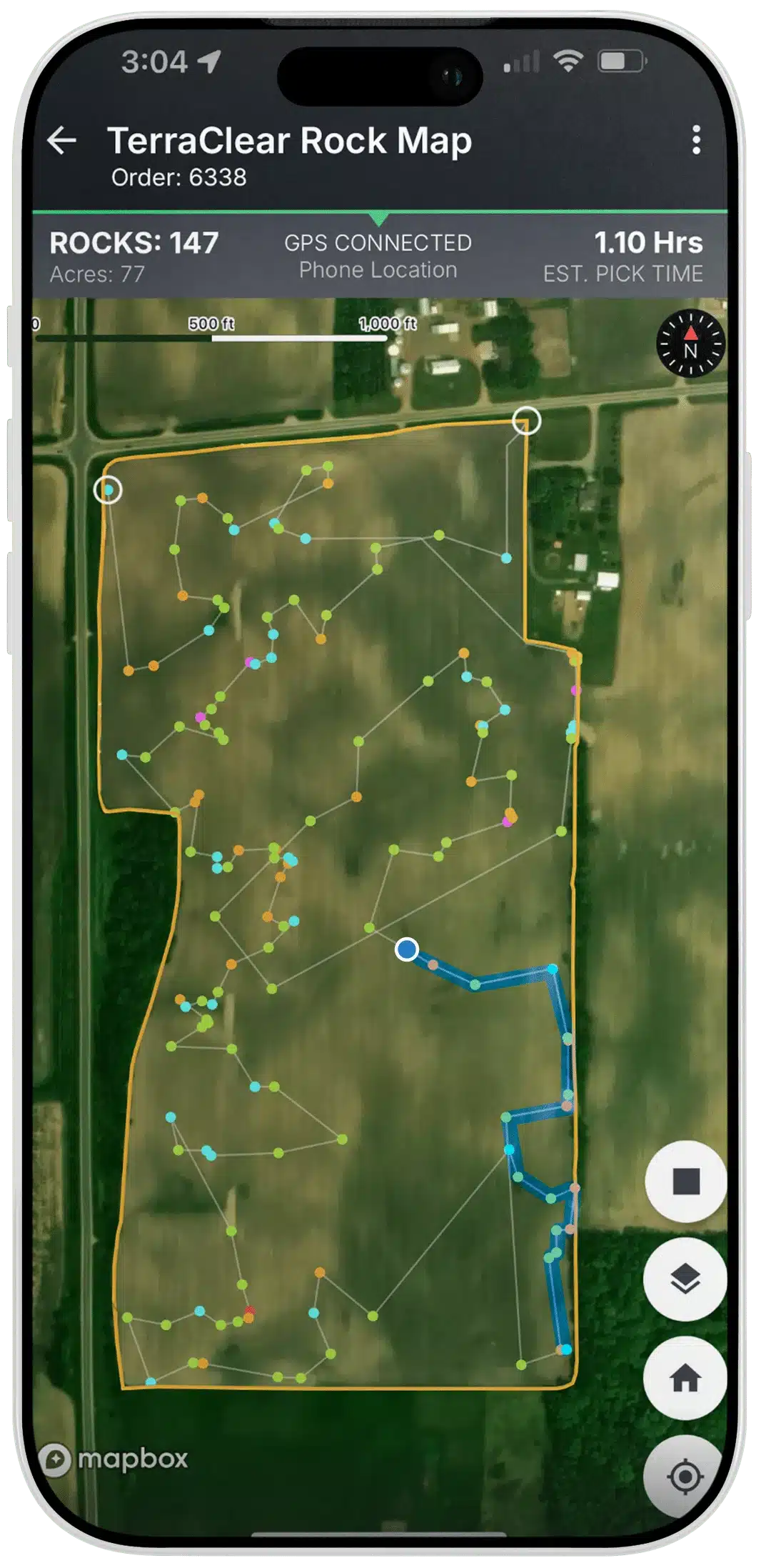
You can pick with the loader, a side-by-side, or a rock picker you already own. The precision comes from the map. If you’d rather not pick at all, TerraClear can refer you to independent stone picking operators in your area who work from your map.
The results hold up on the Prairies. One Saskatchewan farmer quoted on terraclearinc.ca said, “Using the Rock Map, I was able to pick in just an hour and a half vs. over 7 hours.” Across TerraClear customers, farmers pick about 3x faster and spend up to 80% less time picking.
Should you pick stones this fall or wait until spring?
On stony ground, do both. Clear the worst fields this fall, then clean up what heaved over winter before seeding.
| Fall pick | Spring pick | |
|---|---|---|
| Time available | After harvest, before freeze-up | Between snowmelt and seeding |
| Labour | Competes with fall tillage and fieldwork | Competes with seeding prep |
| Frost heave | New stones will still surface over winter | Catches the stones that heaved over winter |
| When to map | After your last fall tillage pass | After snowmelt, before spring tillage |
| Best for | Getting ahead on your worst fields | Final cleanup before the drill |
A fall pick shrinks the spring job. It won’t erase it, because frost heave keeps working all winter.
What do stones cost you at harvest?
Stones cost you twice: in repairs and in bushels left on the ground.
Start with repairs. A stone through the header can take out guards, knife sections, and more, and it always seems to happen when a lost day hurts most. Danny Buls put it simply: “As everybody knows, [the breakage] on combines can be pretty substantial.”
Then there are the bushels. Stones set your cutting height. South Dakota State University Extension’s soybean guide notes that “rocky areas or soil mounds require the operator to raise the combine header and sacrifice low hanging pods, leaving them in the field.” In soybeans, header loss can be responsible for as much as 90% of total harvest loss, according to Iowa State University Extension. Any crop you cut close to the ground carries the same risk.
Rolling isn’t removal, either. A land roller presses stones down. It doesn’t take them out, and they’ll be back. Iowa State soil scientist Mahdi Al-Kaisi has cautioned that rolling can crush surface soil aggregates and raise the risk of crusting and erosion.
What does Danny Buls say about his TerraClear Rock Map?
Danny Buls farms near Sumner in northeast Iowa. Before TerraClear, getting stones out ahead of the planter depended on finding help at the right time. “Since TerraClear’s been around, it’s made that whole part much easier,” he said.
At harvest, it shows up in the cab. “[When you’re] combining, you really enjoy that, not watching for them rocks,” Danny said. With that peace of mind, he can run later at night, “and everybody has a better day.”
He also values that the work gets done when promised. “If they say they’re gonna do it, they get it done.”
Frequently asked questions about fall stone picking
Can you map stones in the fall after harvest?
Yes. A TerraClear Rock Map works any time stones are visible from above, including through stubble and residue after harvest. Avoid flying with snow on the ground.
How fast do I get my Rock Map?
Maps are delivered the next day on average after the flight.
Do I need a new Rock Map in the spring?
If you plan to pick again before seeding, yes. Frost heave brings new stones to the surface over winter, so a spring map made after snowmelt catches stones the fall map couldn’t. Buy it before spring to lock in the best rate.
Can I till after the flight?
Not until you finish picking the mapped stones. Tillage moves stones and brings new ones up, so the map no longer matches the field.
What size stones does a Rock Map find?
TerraClear Rock Maps detect stones 20 cm (8″) and larger, each with a GPS-pinpointed location and a photo.
Does TerraClear pick the stones?
No. TerraClear makes the map. You pick with your own equipment and crew, or TerraClear can refer you to an independent stone picking operator.
Get your fall map on the calendar
The window between harvest and freeze-up is short. Talk to a rep about mapping your stoniest fields this fall. Ask about booking your spring map now to lock in the best rate, and find out who covers your RM.
Talk to a rep about a fall map
Sources
- Glacial Deposition, The Encyclopedia of Saskatchewan, University of Regina
- Glacial Erratics, North Dakota Department of Mineral Resources
- Verifying Combine Adjustments During Crop Harvest, Kapil Arora, Iowa State University Extension, Sept. 26, 2019
- Soybean production guide, South Dakota State University Extension
- Rolling Stones: If You Have Rocks (and Root Balls), Should You Roll?, Farm Progress