


Precision Ag in the Canadian Prairies: Closing the “Cognition Gap” with TerraClear
In the vast landscapes of Saskatchewan and across Western Canada, efficiency isn’t just a goal—it’s a survival mechanism. A recent deep-dive discussion featuring Devon Lammers (CEO of TerraClear) and Canadian producer Christian Hebert highlights a major shift: we are moving past simple data collection into the era of “Blackjack Farming.”
For the Canadian grower, this means using AI-driven rock mapping, autonomous scouting, and high-resolution imagery to remove the guesswork and maximize every hour of the short Northern growing season.
Here’s a summary (TLDR) of this excellent interview:
1. The Challenge of “Big Acre” Data in Canada
Farming 5,000-acre fields in Canada presents challenges that smaller US operations don’t face. When you scale, manual errors and “low-resolution” data become massive financial leaks.
- The Resolution Problem: Satellite data (2-meter) is great for broad strokes, but it can’t see a rock that will wreck a header or a weed the size of a quarter.
- The Solution: TerraClear’s ground-based and drone-based systems provide millimeter-level resolution. We are talking about the difference between seeing a field and seeing every individual plant.
- Edge Compute for the Prairies: In areas with limited connectivity, you can’t wait for the cloud. TerraClear utilizes edge compute—processing data right at the field edge—to turn billions of images into a mission plan in real-time.
2. Rock Mapping: The First Step to Autonomous Efficiency
Rock picking is universally hated, but in Canada, it is a significant operational expense. By “gamifying” the process through precision rock mapping, the ROI becomes undeniable.
The ROI of High-Tech Rock Picking
- Direct Cost Savings: Canadian operations have benchmarked rock picking at nearly $4.80–$5.00 CAD per acre when accounting for wages, fuel, and depreciation.
- Harvest Security: The real value is found in the fall. Mapping and removing 100% of problematic rocks means fewer “catastrophic stops” during harvest. No more rock-damaged rotors or mangled headers.
- Operational Speed: By following the seeder tracks with an AI-generated map, one operator can be 5 to 7 times more productive than a traditional crew “hunting” for rocks by eye.
“We used to finish rock picking three weeks after seeding. With TerraClear’s mapping, we were done three days after the drills stopped.” — Christian Hebert, Hebert Grain Ventures
3. Introducing TerraScout: The Future of Autonomous Scouting
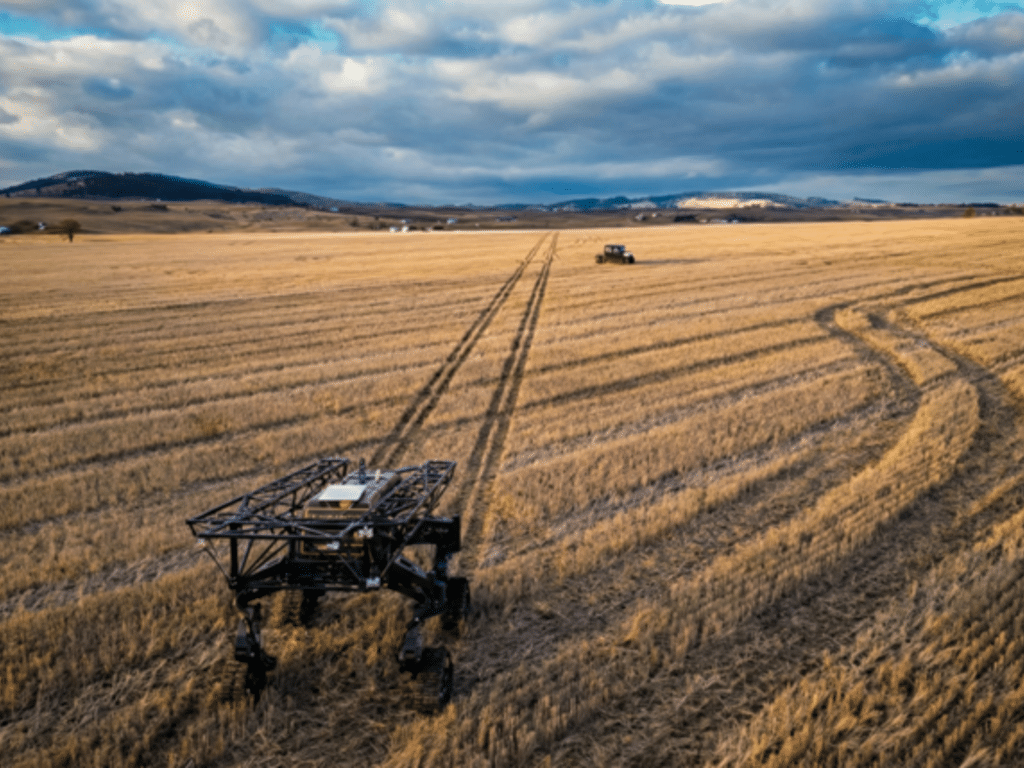
The wind in Saskatchewan can ground a drone 50% of the time. To solve the “missing data layer,” TerraClear developed the TerraScout—a ground-based autonomous rig designed specifically for large-scale production agriculture.
- High-Speed Execution: Designed to drive at 15 mph with a 60-foot boom, it covers massive acres day or night without a pilot.
- The Plant-Level View: It captures 4 billion images per acre. This allows the AI to calculate true germination counts and emergence timing automatically.
- Closed-Loop Trials: Imagine running a fertilizer trial and having the TerraScout report back every 10 days on plant vigor, leaf stage, and flea beetle pressure—allowing you to make insecticide decisions before the damage is done.
4. Standardizing the “Canadian Farm Stack”
To leverage AI, Canadian farms must move away from “garbage” data. Precision ag only works when the foundation is solid.
| Step | Implementation Strategy |
| Unified Naming | Ensure field names are identical in John Deere Ops Center, your accounting software, and your mapping tools. |
| SOPs over Manual Entry | Remove the chance for manual error. Use pre-populated work plans so operators don’t have to type data into the monitor. |
| Collaboration | TerraClear integrates with existing platforms. The goal is a “Simple Button” that pushes mission plans directly to your current fleet. |
5. 2026 and Beyond: From Gut Feel to Probability
The next 50 years of Canadian agriculture won’t be about better iron; it will be about executable intelligence.
- Foundation Models: We are moving toward AI that understands the relationship between soil samples, as-applied maps, and high-res imagery to give you a “Financial Scorecard” for every acre.
- Self-Managed Teams: When the data shows an 80% probability of a fungicide ROI, the system can automatically deploy the team. This empowers the staff and removes the “Key Man” risk for the owner.
- The “Hologram” Vision: Managing a farm from a coffee shop in France is becoming a reality. With scorecards for weather, finance, and operations all talking to each other, the farm becomes a repeatable, scalable business.
Conclusion: Efficiency is the New Commodity
In a commodity-based business, the most efficient producer wins. By closing the “cognition gap” with TerraClear’s rock mapping and autonomous scouting, Canadian growers can finally achieve the promise of precision ag: higher yields with lower inputs.
The “Simple Button” for your farm is here. It’s time to stop putting in time and start managing by the acre.